What Is Greece Famous For? Key Facts About Greece
Greece is a country in south-eastern Europe, at the southern tip of the Balkan peninsula, and its capital is Athens. It is known as the cradle of Western civilisation: philosophy, democracy and the Olympic Games were born on its soil, and it gave the world Socrates, Plato, Aristotle and Pythagoras. In this guide we answer the most common questions about Greece: where it is, what it is famous for, its language and currency, and how travellers from Saudi Arabia obtain a visa.
Book Athens hotels→| Location | South-eastern Europe — the Balkan peninsula |
| Capital | Athens |
| Official language | Greek (English is widely spoken in tourist areas) |
| Currency | The euro (€) |
| Population | Around 10.4 million |
| European Union | A member since 1981, and in the Schengen Area since 2000 |
| Number of islands | Around 6,000 islands, of which roughly 227 are inhabited |
| Best time to visit | May–June and September–October |
Where is Greece?
Greece lies in the south-eastern part of Europe, specifically in the south of the Balkan peninsula, at the meeting point of three continents: Europe, Asia and Africa. Its coasts look out onto three seas: the Mediterranean to the south, the Aegean to the east and the Ionian to the west — which has made its position commercially and touristically important throughout history. Among its best-known ports is Piraeus, near Athens.
Greece shares land borders with four countries: Albania to the north-west, North Macedonia and Bulgaria to the north, and Turkey to the north-east. It covers around 132,000 square kilometres, with terrain ranging from mountains and plains to thousands of islands. Among its most distinctive features are the Greek islands, numbering around 6,000, of which only about 227 are inhabited.
What is Greece famous for?
Greece's fame cannot be reduced to a single field — it is known for its history, its culture and its landscapes alike:
Landscape and islands
Most of Greece is mountainous, threaded with coastline and some of the most beautiful beaches in the Mediterranean, along with thousands of islands known for their white houses and blue domes, such as Santorini, Mykonos and Crete.
Ancient remains and architecture
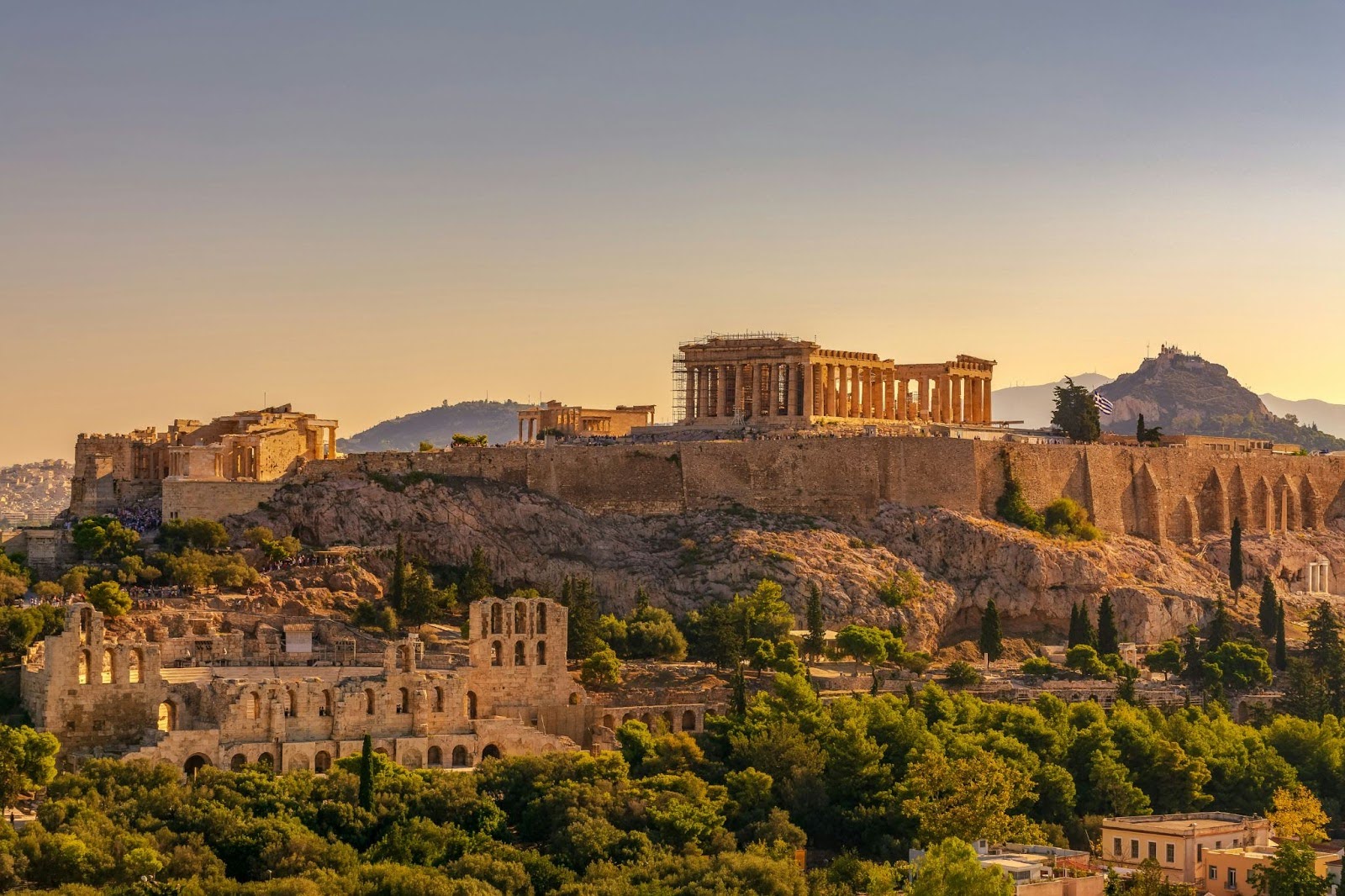
The ancient Greek temples with their famous columns — above all the Acropolis and the Parthenon in Athens — remain among the most important archaeological sites in the world, and Greek architecture is still a source of inspiration today.
Philosophers and history
Greece is the home of Socrates, the founder of Western philosophy, of his pupil Plato and then Aristotle, and it is where Alexander the Great set out on conquests that reached the borders of India. It is also where the ancient Olympic Games were born, at Olympia.
What is the official language of Greece?
The official language is Greek, one of the oldest living languages in the world, written in an alphabet of 24 letters. English is widely spoken in the cities and tourist areas and is taught in schools, so travellers will have no difficulty communicating in hotels, restaurants and at the sights. Knowing a few simple Greek words is useful in everyday dealings outside the tourist areas.
Is Greece in the European Union?
Yes, Greece has been a member of the European Union since 1981 and was one of the first countries to join. It has also been in the Schengen Area since 2000, and has used the euro as its official currency since it first entered circulation. That means a Schengen visa issued by any country in the area allows entry to Greece, and vice versa.
The people of Greece and the main religion
Greece's population is around 10.4 million, and the vast majority — more than 90% — follow Eastern Orthodox Christianity, which the constitution recognises as the prevailing religion. Greek people are known for their warmth and hospitality and their attachment to tradition and family.
Greece has a historic Muslim minority concentrated mainly in Thrace in the north-east of the country, as well as immigrant Muslim communities in Athens and the major cities, and the capital's first official mosque opened in 2020. Halal restaurants are available in Athens and the main tourist areas, though they are less widespread than in some other European destinations.
The Greek visa for Saudi nationals
Saudi nationals need a Schengen visa to enter Greece, applied for through the approved visa centres (VFS Global) in Riyadh, Jeddah and Khobar. The visa fee is around 90 euros for adults and 45 euros for children aged 6 to 12 (fees are subject to change, and the centre's service fee is added on top), and it usually takes two to four weeks to issue — so applying well before your travel date is advisable.
The good news: since April 2024 Saudi nationals have been able to obtain a multiple-entry Schengen visa valid for up to 5 years under the European Union's eased rules for Gulf nationals, while the 90-day maximum stay within every 180 days still applies. The main documents required are: a valid passport, flight and hotel bookings, travel insurance covering the Schengen Area, and a bank statement.
The best time to visit Greece, and flights from Saudi Arabia
The two best periods to visit Greece are May to June and September to October: mild weather, a sea warm enough for swimming, and hotel prices lower than the peak of July and August, when prices, heat and crowds all rise together.
Getting there from Saudi Arabia is easier than ever: Saudia operates seasonal direct flights from Jeddah and Riyadh to Athens through the summer of 2026 (June to September), with three flights a week from each city, and Aegean operates direct flights on the same route. The direct flight takes roughly 4.5 to 5 hours. For the rest of the year there are one-stop flights via Istanbul, Cairo or Dubai.
Search for flights to Athens at the best prices→The best-known tourist places in Greece
Greece brings together World Heritage sites and enchanting islands. Among the places most worth visiting:
- The Acropolis and its museum in Athens — Greece's foremost icon, along with the old Plaka quarter with its lanes and cafés.
- Santorini — the white houses, the blue domes and the most famous sunset in the Mediterranean.
- Mykonos — the beaches and the traditional windmills.
- Crete — the largest Greek island, combining beaches, history and mountain scenery.
- The monasteries of Meteora — monasteries built atop towering rocks, a World Heritage site.
- The ancient city of Delphi — the best-known of the ancient Greek religious sites.
- Corfu, Rhodes and Zakynthos — with their famous beaches and turquoise water.
Read our detailed guide to the most beautiful Greek islands to choose the right one for your trip.
Book Athens hotels at the best prices with Tjwaal→Frequently Asked Questions about Greece
Where is Greece?▾
Greece lies in south-eastern Europe on the Balkan peninsula, looking out onto the Mediterranean, the Aegean and the Ionian seas, and bordered by Albania, North Macedonia, Bulgaria and Turkey.
Do Saudi nationals need a visa to enter Greece?▾
Yes, Saudi nationals need a Schengen visa, and since April 2024 a multiple-entry visa valid for up to 5 years has been available. Applications are made through the VFS Global centres in Riyadh, Jeddah and Khobar.
What is the official currency of Greece?▾
The euro (€) is the official currency of Greece, which is a member of the European Union and the eurozone.
What is the official language of Greece?▾
Greek is the official language, and English is widely spoken in the cities and tourist areas.
How many Greek islands are there?▾
Greece has around 6,000 islands and islets, of which only about 227 are inhabited — the best known being Santorini, Mykonos, Crete and Rhodes.
How long is the flight from Saudi Arabia to Greece?▾
The direct flight from Jeddah or Riyadh to Athens takes roughly 4.5 to 5 hours, with seasonal direct flights in summer and one-stop flights for the rest of the year.
Plan your trip to Greece with Tjwaal: compare Athens hotel and flight prices and book at the final price including taxes, with the option to pay in instalments through Tamara.